
Pokies Parlour Casino in Australia: What It Means
 Available in AU
The phrase does not identify a national casino brand; each Australian casino property is licensed in its state or territory.
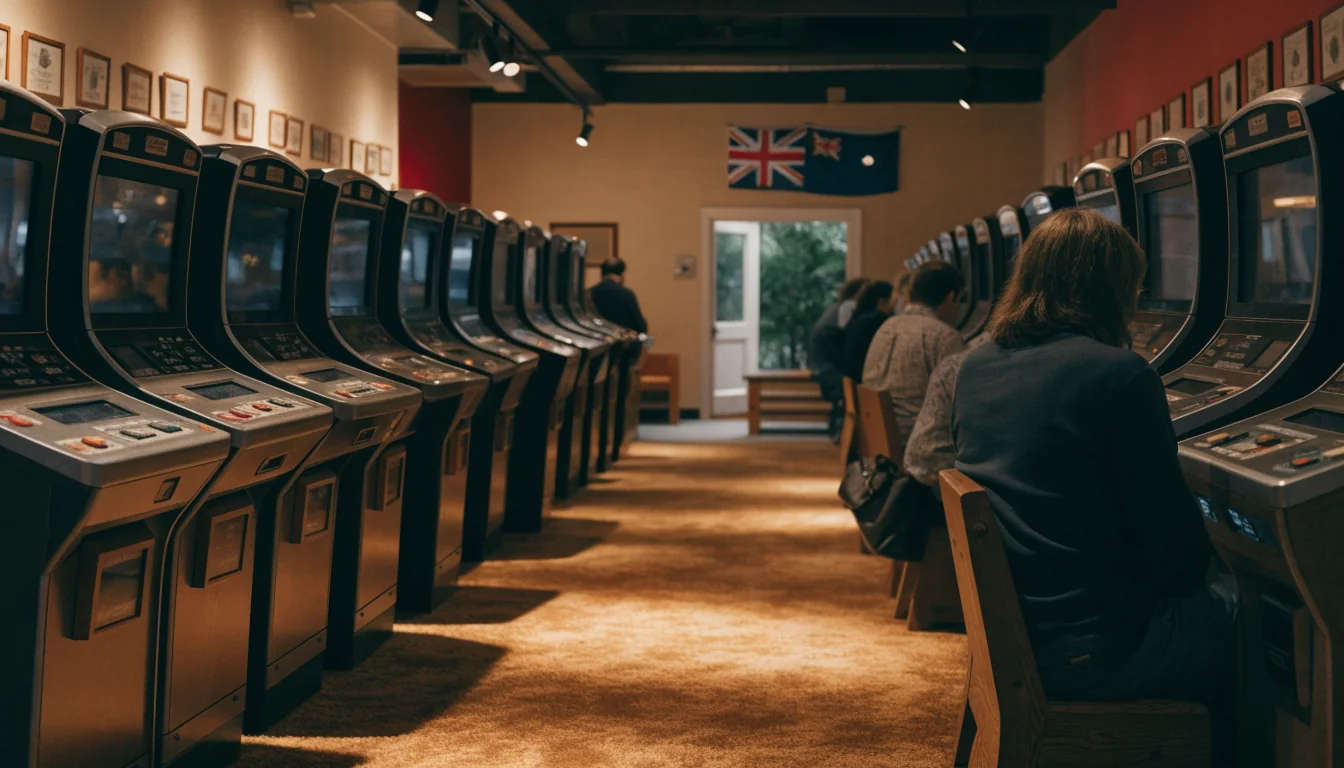
- What “Pokies Parlour” Means in Australia
- No-Deposit Bonuses and Sign-Up Offers: What the Rules Mean
- Playing Online or for Free: Check What the Site Actually Is
- Free Spins and Chips: A Search Term Is Not an Offer
- How to Read a Pokies Parlour Review Carefully
- The Australian Casino Map: Cities and Jurisdictions
- Casino Bonus Claims and Illegal Services
- VIP Parlours, Entry and Venue Access
- Pokies in Parlour Settings: The Verified Machine Figure
- Real-Money Casino Searches and Australian Domain Blocks
What “Pokies Parlour” Means in Australia
“Pokies parlour” can suggest a physical place where people go to play gaming machines, and adding “casino” may lead you to expect a particular venue or chain. The phrase alone, however, does not identify a separately established Australian casino brand. The verifiable information relevant to it concerns the country’s casino sector: individual properties, each operating under a licence issued by the state or territory where it is located.
That distinction matters when you are trying to work out what a venue is. A familiar-sounding label is not evidence that a business is a casino, that it holds a casino licence, or that the same name refers to one operator across Australia. The useful starting point is the specific property and its jurisdiction, not the broad phrase used to describe it.
Australia does not have one national casino licence covering every property. Casino regulation sits with state and territory governments, and each property’s licence comes from its local jurisdiction. In practical terms, the rules and official information relevant to one casino are connected to the place where that casino operates. A national description of the industry can provide context, but it does not replace checking the status of an individual venue with the relevant jurisdiction.
If you’re looking for a pokies parlour-style casino in Australia, a concise reference can help you check what is known about each option before deciding what to explore. The details below are limited to the information available for each operator.
License: Curacao eGaming OGL/2024/923/0383 (Antillephone N.V.) · Min. deposit: A$30 You can note its Curacao eGaming licence, OGL/2024/923/0383, issued through Antillephone N.V. The stated minimum deposit is A$30.
License: Curacao Gaming Control Board OGL/2023/174/0082 (Dama N.V.) You can check its stated Curacao Gaming Control Board licence, OGL/2023/174/0082, held by Dama N.V.
License: Curacao eGaming (Hollycorn N.V., since 2017) · Min. deposit: A$20-30 (depends on the offer) You can note that Hollycorn N.V. has operated it under a Curacao eGaming licence since 2017. Its minimum deposit is A$20–30, depending on the offer.
License: Curacao, operated by Dama N.V. You can note that 7Bit Casino is operated by Dama N.V. and is licensed in Curacao.
License: Curacao (operating since 2017) · Min. deposit: A$20 You can consider its stated Curacao operation, which has been running since 2017. The minimum deposit is A$20.
License: Curacao Gaming Authority (Jumpman Gaming Ltd) You can note its Curacao Gaming Authority licence and that it is operated by Jumpman Gaming Ltd.
License: Curacao Gaming Control Board You can check its stated Curacao Gaming Control Board licence.
Payout speed: crypto under 1 hour, PayID 1-3 business days · Min. deposit: A$20 (A$30 to qualify for the bonus) You can deposit from A$20, though A$30 is required to qualify for the bonus. The stated payout times are under an hour for crypto and 1–3 business days for PayID.
Payout speed: crypto ~90 minutes, fiat 1-5 days · Min. deposit: A$30 You can note its stated payout speeds: about 90 minutes for crypto and 1–5 days for fiat. The minimum deposit is A$30.
License: Curacao · Min. deposit: A$20 (POLi) You can note its Curacao licence and A$20 minimum deposit when using POLi.
This framework also explains why a term such as “parlour casino” can be imprecise. It may be used informally to describe a physical gaming venue, but it does not tell you whether the venue is a casino operating under a casino licence or some other kind of gaming establishment. The licensing fact that can be stated consistently is narrower: Australian casino properties are licensed by their respective state or territory. The label is not a substitute for that distinction.
The scale of the sector is sometimes summarised as more than twenty full-scale casinos distributed across all eight Australian states. That count comes from a specialist casino review, so it is best read as that review’s description of the market rather than as a permanent official total. The number of properties can change, and a count is only meaningful when its source and scope are clear. “Full-scale casino” is also not a complete description of every place in Australia where gambling occurs.
For you as a reader, the practical point is that a general reference to Australian casinos and a claim about one particular “pokies parlour” are different things. The first concerns a sector regulated across state and territory boundaries. The second needs to be tied to an identifiable property and the local jurisdiction responsible for its casino licence. Without that connection, the phrase may describe an idea, but it does not establish a venue’s legal or commercial identity.


The jurisdictional structure makes local context important, but it does not mean that every casino has the same operating arrangements or that one state’s licence covers a property elsewhere. Each casino property is licensed locally. If a description names a venue, the relevant question is whether that named property is recognised as a casino in its jurisdiction—not whether a broad label sounds familiar or appears in a promotional description.
The word “parlour” can also make a search result sound more specific than it is. It may imply a small, dedicated room or a single kind of venue, but the phrase itself supplies no reliable detail about ownership, licensing, or the facilities available. Those details must come from information about the particular property. Treating a generic label as though it were a verified brand would blur the difference between the way a place is described and the regulatory status of the business behind it.
So, in Australian usage, “pokies parlour” is best treated as a description that may point toward a physical gaming venue, not as a confirmed name for a national casino operator. The casino market is organised through locally licensed properties across the states and territories. That is the dependable context for understanding the phrase; it does not, by itself, identify a specific venue or establish that a business using similar wording is a casino.
Market Australia
Language English
Casino Licensing State and territory based
No-Deposit Bonuses and Sign-Up Offers: What the Rules Mean
A “no-deposit” or sign-up bonus can sound like a simple offer: a new customer is promised a benefit without making an initial payment. But the wording alone does not show that an offer exists, that it is available to someone in Australia, or that it is lawful to provide or advertise here. Those are separate questions, and promotional language cannot settle them.
The starting point is the service behind the offer. Under the Interactive Gambling Act 2001, operators must not provide real-money online casino games to people physically in Australia. That covers casino-style games such as slots, poker and table games. A welcome credit or other inducement does not change the nature of the underlying service. Calling it free, no-deposit or a sign-up reward does not create an exception to the law.
That distinction matters because a promotion can be presented as though it were separate from gambling. In practice, its meaning depends on what it is attached to and what a recipient is invited to do. If the benefit is tied to real-money online casino play for Australian customers, the promotional wording does not make that service permissible. Nor does a claim that an offer is intended for new members establish that Australian readers are eligible to receive it.
The rules also concern advertising, not only the act of accepting an offer. Real-money online casino services may not be advertised to Australian audiences. A bonus banner, promotional email or sign-up message does not become lawful merely because it discusses a reward rather than naming a game. The relevant issue is the service being promoted and the audience being targeted. General restrictions on gambling inducements do not override the prohibition on advertising online casinos.

This is why a broad phrase such as “casino bonus” is not enough to establish a promotion’s status. It may appear on a page, in a message or in a description of an offer, but that appearance does not confirm that the offer is current, genuinely available to Australians or authorised under Australian law. It also does not show whether the underlying service is one that may legally be provided to people in the country. The wording is a claim; the legal position depends on the conduct it describes.
Enforcement is not left to the reader to resolve from promotional copy. The Australian Communications and Media Authority, known as ACMA, oversees compliance with federal interactive gambling laws, including the Interactive Gambling Act. Where a service is prohibited, the regulator can investigate and act against an operator that provides it or advertises it. ACMA can also ask Australian internet service providers to block access to websites offering prohibited interactive gambling services or promoting them in Australia.
That division of responsibility is useful to understand. A reader may encounter an offer, but the existence of an advertisement is not evidence that the regulator has approved it. Likewise, a site’s own description of its promotion cannot establish that the offer complies with Australian law. Regulatory responsibility sits with the businesses and advertising activity involved; promotional language does not transfer that responsibility to the person reading it.
Legal Prohibition
Under the Interactive Gambling Act 2001, real-money online casino games cannot be provided to people physically in Australia.
The timing or presentation of a message does not change the basic distinction either. Restrictions on gambling inducements and promotions apply in their own right, while the ban on advertising real-money online casinos to Australian audiences is a separate constraint. An offer cannot be made acceptable simply by changing its label, placing it in a different format or describing it as a sign-up benefit. Where the underlying service is prohibited, a promotional wrapper does not cure the problem.
For Australian readers, the practical point is narrower than a list of bonus terms: a headline promising a reward is not proof of a lawful offer. Treat claims about no-deposit access or new-customer benefits as claims made by whoever published them, not as confirmation of availability or approval. The governing question is whether the service and its promotion are permitted for people in Australia. ACMA’s enforcement role exists because that question is not answered by the offer’s wording.
Playing Online or for Free: Check What the Site Actually Is
A page that looks like a casino can offer very different things: information about a physical venue, a game that does not use real money, or an online service involving gambling. The design alone will not tell you which it is. Nor does a site become an Australian-authorised casino because it loads on your device, accepts account activity or displays an Australian-facing name.
That distinction matters because Australia does not permit operators to provide real-money online casino games to people in the country. The Interactive Gambling Act 2001 covers casino-style services such as online slots, poker and table games. A foreign licence, an Australian theme or a working sign-up page does not change that restriction. The law concerns the service offered to customers in Australia, not simply the wording on a website.

“Free play” needs a closer look, too. It can describe a game that is only for entertainment and does not involve real-money gambling, but the label is not enough to establish what happens in practice. Check whether the site asks you to create an account, whether play is connected to deposits or withdrawals, and whether it presents gambling services alongside the free game. These details help identify the kind of service being offered; they do not make a prohibited real-money casino service lawful.
A site may also present itself as a venue’s online counterpart without being a physical casino’s official channel. The word “parlour” in a name or page title is not evidence of a venue, a local operator or a licence. If a page claims a connection to a bricks-and-mortar casino, look for confirmation from the venue itself rather than relying on branding or a matching logo. A resemblance is easy to create; the relationship behind it is what matters.
There is another complication: the address in a browser can change. A specialist review describes how website blocking may affect which domains Australian internet providers can reach, while alternate addresses may appear at different times. That can leave users seeing a page move, stop loading or reappear at another address. None of those changes settles the regulatory question. An alternate domain is still just an address, not proof that the service is authorised in Australia.
Website Access
Website blocking by ACMA may affect which domains are reachable through Australian internet service providers.
For the same reason, access is a poor test of status. A site that opens may still be offering a prohibited service; a page that fails to load may be affected by blocking or by an unrelated technical problem. Either way, the result tells you about access at that moment, not whether the operator may lawfully provide online casino gambling to people in Australia. ACMA, the federal regulator, can take enforcement action in this area, including seeking website blocks through Australian internet providers.
If you are trying to understand what a page offers, read its terms and descriptions carefully, and separate claims about free entertainment from claims involving deposits, cash prizes or withdrawals. Be cautious about requests for personal or payment details before you can establish what service is behind the page. Do not treat a working account, a familiar venue name or a new web address as a substitute for that assessment.
The practical answer to an online or free-play offer is not determined by whether the page appears on screen. First establish whether it is information about a physical venue, a non-money game or an online gambling service. Then consider the legal boundary that applies to the service itself. A site’s appearance and accessibility can change; neither supplies Australian authorisation.

Free Spins and Chips: A Search Term Is Not an Offer
Looking for free spins, a free chip or another casino-style extra can make a result sound like a definite promotion. It is not. Those words may appear in a page title, an advertisement or a description written to attract attention; their presence does not establish that an offer exists, that it is current, or that it can lawfully be made to people in Australia.
The distinction matters because an online casino promotion is not separate from the service it is designed to encourage. Under the Interactive Gambling Act 2001, operators cannot provide real-money online casino games to people physically in Australia. That prohibition covers casino-style games such as slots, poker, blackjack and roulette. A promotional label does not change the nature of the underlying service.
The Australian Communications and Media Authority (ACMA) is the federal regulator responsible for enforcing the Act and monitoring compliance with federal interactive gambling laws. It can investigate operators that provide or advertise prohibited services, and it can ask Australian internet service providers to block websites involved in providing or advertising them. These are enforcement measures, not signs that a promotion has been checked and approved for Australian customers.
ACMA’s published enforcement record indicates that it has blocked more than 1,455 illegal gambling and affiliate websites since November 2019. Affiliate sites are pages that promote or direct people towards gambling services, rather than necessarily operating the gambling service themselves. The scale of blocking action is a useful warning against treating promotional language as a regulatory assurance: a polished page or an appealing offer can still be associated with a prohibited service.
Important Distinction
Promotional language and website accessibility are not evidence of legal authorisation in Australia.
This also means that “free” should not be read as a safety label. A chip or spin described as free may still be attached to an online casino service, and the word alone tells you nothing about the operator’s legal position. Nor does a promotion become permissible simply because it is discussed by a third-party page rather than presented directly by the gambling operator. Advertising prohibited online casino services to Australian audiences is not allowed.
For a physical gaming venue, an online promotion’s wording should not be taken as evidence of an in-person offer either. The phrase “pokies parlour” can refer loosely to a venue in everyday use, but a page using that language may be discussing an online service instead. The setting and the legal framework are different; a familiar venue-style name does not establish that the page refers to a licensed Australian casino.
The practical point is straightforward: treat claims about spins, chips or casino extras as claims, not as proof of an available or lawful offer. ACMA’s enforcement activity shows that illegal gambling and affiliate websites are a real part of the online landscape. A promotion can be attention-grabbing; that is not the same as being authorised for Australian customers.
How to Read a Pokies Parlour Review Carefully
A review can be useful for describing a venue or explaining what its writer checked. It cannot, by itself, establish that an online gambling service is authorised for people in Australia. Treat claims about licensing, access and ownership as separate claims, and look for evidence that actually supports each one.

Start with the subject of the review. “Pokies parlour” may refer to a physical gaming venue, while a page using similar wording may discuss an online service. Those are not interchangeable. Check whether the writer identifies a place you can visit or a website, and whether the details match that subject. A review that moves between venue information and online account claims without explaining the difference is difficult to assess.
Next, examine what the page means by “verified”. Does it link to a regulator’s information or merely repeat the operator’s own description? Does it state when the check was made, and what was checked? A statement that a site is “licensed” is incomplete if it does not identify the authority and the service covered. An image of a licence or a badge on a page is not the same as confirmation from the body said to have issued it.
Domain claims need particular care. Australian internet-service-provider blocking can affect which web addresses resolve for users, and other addresses may appear over time. That means a site failing to load does not, on its own, explain why; nor does an address that loads establish Australian authorisation. A review that treats either result as proof is claiming more than the observation shows.
ACMA enforcement notices have documented website-blocking action against illegal gambling services, including alternate domains associated with Fair Go. The practical point is not that every changed address has the same status. It is that a new address, a redirect, or a page that remains reachable should not be mistaken for regulatory approval. Blocking is an access measure; it is not a certification system.
- Check specific property details with the local jurisdiction
- Verify venue information directly with the physical establishment
- Treat generic labels like “pokies parlour” as verified brands
- Assume an accessible website is an authorised service
Look also at how the review handles changes. A page may retain old screenshots, outdated access instructions or claims that no longer match the site. If it gives no date for its checks, you cannot tell whether its description is current. When the writer says that an alternate domain is “official”, ask what independent record supports that wording rather than relying on the site’s own announcement.
Finally, separate firsthand description from conclusions. A writer may report that a page opened, that a particular address redirected, or that a support message made a claim. Those observations do not establish who operates the service, what jurisdiction covers it, or whether it is permitted to serve people in Australia. A careful review makes those limits clear instead of turning a technical detail into a trust signal.
The most reliable reading is therefore a narrow one: take a review as an account of what its author observed, then assess any regulatory conclusion against information from the relevant public authority. If the evidence is only an accessible address or the operator’s own assurance, the review has not shown that the service is authorised.
The Australian Casino Map: Cities and Jurisdictions
Australia’s gambling venues are spread across cities and jurisdictions rather than concentrated in a single national gaming district. A specialist gambling-directory review counts gambling facilities in 147 Australian cities. That figure is a snapshot from a directory, not a permanent census: venues can change, and the boundaries of what a listing counts as a facility matter.

The same review identifies Sydney, in New South Wales, as the country’s largest gambling city, listing 11 facilities there. That gives a sense of the urban concentration, but it should not be read as a complete measure of gambling activity in the state or as a ranking that will remain unchanged. A city count describes listed venues, not how many people visit them or what kinds of facilities they are.
Location also matters because Australia does not have one national casino licence. Casino properties are licensed by the state or territory where they operate, so a venue’s address places it within a particular jurisdiction’s framework. For a reader comparing places, a map can help distinguish a city’s venue listings from the rules that apply to a specific property.
The Northern Territory offers a smaller-scale example. A specialist gambling-directory review lists three casinos across three cities in the Territory. It names Alice Springs as having the most casinos there, with one. The wording is an awkward reminder that directory categories and counts are not always intuitive: the figures describe the listings, not a broad claim that Alice Springs is a major casino hub by national standards.
Other named locations show how far apart Australian gaming venues can be. Jupiters Gold Coast Casino & Hotel is on Broadbeach Island, on the Gold Coast. Country Club Casino is listed on Country Club Avenue in Prospect, within Meander Valley. These places sit in different state jurisdictions and very different urban settings; a national search result alone does not tell you which local rules or venue details apply.
Located in New South Wales, it is the country’s largest gambling city with 11 listed facilities.
Lists three casinos across three cities, with Alice Springs having one.
Home to the Jupiters Gold Coast Casino & Hotel on Broadbeach Island.
A geographic list is useful as a starting point, but it is not a substitute for checking a property’s current information or its jurisdiction. The count of facilities in a city is not the same as a count of casinos, and a venue listing does not establish that every gambling activity is available there. Read city totals as directory-based descriptions, then treat the property and its location as the relevant unit when you need practical details.
Casino Bonus Claims and Illegal Services
A casino bonus claim can sound like evidence that a service is available to Australians. It is not. Promotional wording does not change the legal status of the service behind it, and an offer should not be treated as confirmation that an online casino is authorised to serve people in Australia.
The Interactive Gambling Act 2001 prohibits operators from providing real-money online casino games to people physically located in Australia. Casino-style games such as slots, poker and table games fall within that prohibition. Advertising prohibited online gambling services to Australian audiences is also banned. A promotion attached to such a service does not create an exception.
There is a separate enforcement record. The Australian Communications and Media Authority (ACMA) enforces federal interactive gambling laws and can investigate operators that provide or advertise prohibited services. Since ACMA began enforcing the rules in 2017, illegal services have withdrawn from the Australian market. However, published figures disagree: one account says more than 210 services withdrew, while another puts the figure at over 190. Those figures should not be collapsed into a single precise total; the difference is part of the record readers need to understand.

This enforcement context is more useful than treating a bonus claim as a verdict on a site. A promotion may be repeated across pages or attached to changing service names, but repetition does not establish lawful availability. Nor does a claim that a service has left the market, by itself, explain what happened to a particular website or address. Those are distinct questions from whether the promoted activity is permitted for Australians.
If you encounter a claim about a casino reward, separate what the wording promises from what is known about the service and the rules. ACMA’s role is to enforce the law against prohibited operators and advertising; the existence of an offer is not a regulatory endorsement. Readers can consult ACMA’s published information on interactive gambling enforcement rather than relying on promotional copy to explain the law.
VIP Parlours, Entry and Venue Access
A reference to a VIP area does not mean that every Australian casino has one, or that access is available to every visitor. Entry arrangements depend on the venue. Treat “VIP” as a description of a particular venue’s access category, not as a standard feature of a separate kind of parlour.
The nationwide minimum age for casino entry is 18. Major Australian casinos also require valid photo identification, so plan to show ID at the entrance rather than assume that age alone will be enough. If you are visiting with someone who is under 18, do not assume that casino entry rules extend to other parts of a property; access to restaurants or entertainment areas is a separate matter and should be confirmed with the venue.
Venue Entry
- Confirm the physical address of the venue
- Check the venue’s specific identification requirements
- Ensure you have valid photo ID for entry
- Verify the minimum age requirements for the specific property
For a concrete location, Lasseters Casino is at 93 Barrett Drive, Alice Springs, NT 0870, Australia. Check the address and entry arrangements directly with the venue before travelling, particularly if you are looking for a specific access area. A venue’s location does not establish that it offers VIP facilities.
At the entrance, follow the venue’s identification and admission requirements. If staff cannot verify your age or identity from the document you present, entry may not be possible. Keep the distinction clear: the legal age threshold applies nationally, while any additional arrangements for particular areas are venue-specific. A label such as “VIP parlour” is not a substitute for checking what the named physical venue actually provides.
Pokies in Parlour Settings: The Verified Machine Figure
For Australian casinos, the available national figure is 3,308 gaming machines. It counts machines endorsed on venue licences and installed in casinos, so it describes the casino sector as a whole—not a particular parlour, city or individual venue.

That distinction matters if you are trying to work out what a named place offers. A national total cannot tell you how machines are distributed between casinos, whether a particular venue has them, or what is available on a given day. The figure is not a venue-by-venue directory.
“Pokies parlour” may sound like a separate category of gaming venue, but the machine count applies to casinos. It should not be extended to every place that uses the word “parlour” or offers gambling. A label alone does not establish what kind of venue it is or what equipment it has.
The count also uses a specific basis: machines must be both included on venue licences and installed in casinos. It is therefore more precise than a casual estimate of how many machines might be found across all Australian gambling venues. It should not be read as a count of machines in clubs, hotels or other settings.

If you are checking a particular casino, the national number is useful context, not confirmation of local details. Look for information tied to that venue and its current operations rather than treating the countrywide total as a promise about what you will find there.
Real-Money Casino Searches and Australian Domain Blocks
A real-money casino website appearing to work from Australia does not mean it is authorised to provide online casino games here. Under the Interactive Gambling Act 2001, operators cannot provide real-money online casino games to people physically in Australia. An account page loading, or a site accepting account traffic, is not evidence of Australian licensing.
The Australian Communications and Media Authority (ACMA) enforces federal interactive gambling laws. It can ask internet service providers to block websites that offer prohibited gambling services or advertise them in Australia. As a result, a domain may stop resolving through an Australian provider even while another address associated with the service appears online. A specialist review source has described blocking as affecting which domains resolve and noted that alternate addresses can emerge over time; that description is not proof that any such address is authorised.
This makes domain availability a poor guide to regulatory status. A working address may simply not be blocked at that moment, while an unavailable one may reflect a blocking measure rather than a change in the underlying service. Neither outcome establishes permission to offer real-money casino games to Australians.
If you are checking a site’s status, rely on information about the law and ACMA’s enforcement role, not on whether a page opens or whether an alternate address is circulating. Domain changes concern access; they do not turn a prohibited online casino service into a locally authorised one. The distinction matters because access and legality are separate questions, and a browser can answer only the first.
Written by the editors at WishWin Casino.