
Real Money Casino Table Games in Australia: How They Work
 Available in AU
A clear guide to table-game formats, how bets and rounds work, and what can be verified about playing online in Australia.

- What Online Table Games Actually Involve
- Bitcoin and Other Ways Table Games Are Played
- What the Available Facts Can—and Cannot—Say About Odds
- How a Hand, a Bet and a Dice Round Work
- Finding Table Games Near You: What This Guide Can Verify
- How Australian Law Treats Online Casino Games
- Different Table-Game Formats, Without a Rankings List
- Card Bets: Hands, the Banker and a Tie
- Roulette Variants and Their Number Layouts
- Poker’s Aim: Building the Strongest Hand
What Online Table Games Actually Involve
An online table game can be presented in two different ways. In a live-dealer format, a real dealer uses real casino equipment, and video of the game is streamed to players. In an RNG-based format, software called a random number generator determines the outcome. The screen may show a familiar table or wheel, but the process producing the result is different.
That distinction is more useful than the word “online” on its own. It tells you whether the game’s action is being shown through a live video stream or whether its result is generated by software. It does not, by itself, tell you which format is better, more suitable or more reliable. Those are separate claims and need evidence beyond the format label.
What “live dealer” means
A live-dealer game has a person dealing and physical equipment in view of a camera. The video is transmitted to players, so what appears on screen is a stream of a real game taking place, rather than an animation standing in for a dealer. The dealer and equipment are part of the format; the player watches the streamed action.
If you’re choosing a real-money casino for table games in Australia in 2026, use this list as a starting point and check that the operator’s details and terms suit you. The verdicts highlight only the information available for each entry.
License: Curacao eGaming OGL/2024/923/0383 (Antillephone N.V.) · Min. deposit: A$30 You can note its stated Curacao eGaming OGL/2024/923/0383 license, issued through Antillephone N.V., and A$30 minimum deposit.
License: Curacao Gaming Control Board OGL/2023/174/0082 (Dama N.V.) Its listed credential is a Curacao Gaming Control Board OGL/2023/174/0082 license, associated with Dama N.V.
License: Curacao eGaming (Hollycorn N.V., since 2017) · Min. deposit: A$20-30 (depends on the offer) You’ll find a stated Curacao eGaming license through Hollycorn N.V., which has operated since 2017. The minimum deposit is A$20–30, depending on the offer.
License: Curacao, operated by Dama N.V. This entry is identified as a Curacao casino operated by Dama N.V.
License: Curacao (operating since 2017) · Min. deposit: A$20 You can note its Curacao operation, running since 2017, and A$20 minimum deposit.
License: Curacao Gaming Authority (Jumpman Gaming Ltd) Its stated licensing detail is Curacao Gaming Authority, with Jumpman Gaming Ltd named as the operator.
License: Curacao Gaming Control Board The available licensing detail identifies JustCasino with the Curacao Gaming Control Board.
Payout speed: crypto under 1 hour, PayID 1-3 business days · Min. deposit: A$20 (A$30 to qualify for the bonus) You can deposit from A$20, though A$30 is needed to qualify for the bonus. Listed payout times are under an hour for crypto and 1–3 business days for PayID.
Payout speed: crypto ~90 minutes, fiat 1-5 days · Min. deposit: A$30 You can note its A$30 minimum deposit and stated payout times: about 90 minutes for crypto and 1–5 days for fiat.
License: Curacao · Min. deposit: A$20 (POLi) Its listed details include a Curacao license and a A$20 minimum deposit using POLi.
The stream is the defining feature. A digital interface may still appear around it, but that does not make the underlying dealing virtual. Conversely, a screen showing a dealer-like image would not establish that a real person and real equipment are involved. The relevant question is what produces and presents the game’s action, not how polished the graphics look.
“Live” also describes the video format, not a promise about the player’s experience. The term alone does not establish how quickly a stream loads, what controls are available, whether a player can communicate with a dealer, or how a particular game is managed. Those details can vary and should not be inferred from the label.
What an RNG-based game means
RNG stands for random number generator: software that produces the result used by the game. In an online version of a table game, the generator can determine which cards are dealt or where a roulette ball lands. The outcome is therefore created by software rather than captured from a physical deal or spin in a live stream.
The game may still use visual elements associated with a casino table. Cards can appear on a digital layout, and a roulette wheel can be represented on screen. Those visuals do not mean that physical cards were dealt or that a physical ball landed on a wheel. In this format, the displayed event represents an outcome determined by the generator.

The term “random” should not be mistaken for a visible pattern or a guarantee about a particular result. It describes the method used to determine outcomes; it does not tell you what the next outcome will be. Nor does the presence of an RNG establish, on its own, how a game has been tested or what other checks apply. Those are questions about the software and its oversight, not simply about the game’s format.
How to tell the formats apart
When you are reading a description, look for a clear account of what is on screen and what determines the result. A live-dealer description should make clear that a real dealer and real equipment are being filmed and streamed. An RNG-based description should make clear that software generates outcomes, such as the cards dealt or the roulette result.
A table layout alone is not enough to identify the format. Both kinds of game may use familiar casino imagery, and both may be presented through an online interface. The useful distinction is not whether the screen looks like a casino table, but whether the result comes from a live physical game shown on video or from a random number generator.
The distinction can also matter when you are comparing descriptions of online table games. “Live” and “RNG-based” are not names for particular rules or types of bet. They describe how the game is presented and how its outcome is produced. The same broad category of table game can be offered in different formats, so the title alone may not tell you which mechanism is being used.
Uses a real dealer and physical equipment streamed via video to players.
Uses software called a random number generator to determine outcomes.
What the labels do not tell you
Neither format label is a quality rating. “Live dealer” does not automatically mean a game is more transparent, and “RNG-based” does not automatically mean it is less authentic. A stream shows a real dealer and real equipment; an RNG-based game uses software to determine outcomes. Beyond those facts, a label is not a substitute for details about a specific game.
Likewise, a screen that resembles a live table is not proof of a live stream, and a video stream does not explain every rule or feature of the game being shown. If a description leaves the format unclear, the appearance of the interface cannot settle the question. Look for wording that says directly whether a dealer and equipment are streamed or whether a random number generator determines the result.
For anyone encountering casino table games online, that is the basic distinction to keep in view: one format transmits a physical game being dealt by a real person, while the other uses software to produce the outcome. The two can look similar on a screen, but the process behind the result is not the same.
Bitcoin and Other Ways Table Games Are Played
“Bitcoin table games” combines two separate ideas: a table game and a payment method. Bitcoin is a cryptocurrency, but its presence in a service’s description does not tell you what the game involves, how its rules work or what determines its outcomes. It identifies a proposed way to pay, not a distinct kind of table game.

That distinction matters when comparing Bitcoin table games with conventional casino table games. The phrase can make the payment method sound as though it changes the play itself. Nothing about the label alone establishes that it does. It does not show whether a game follows different rules, uses a different betting structure or behaves differently from a game described without reference to Bitcoin. Those details would have to be assessed separately, rather than inferred from the currency.
Nor does the payment label settle questions of reliability or suitability. It does not, by itself, establish how a service handles transactions, whether a particular game is fair, or whether the arrangement is appropriate for you. A Bitcoin reference is not evidence of a game’s quality or a guarantee about how it works. Equally, it does not establish that a conventional payment method would make the game more reliable. These are separate claims, and the label cannot answer them.
The same caution applies to terms such as “BTC casino table games” or “table games for Bitcoin”. They may describe games associated with a Bitcoin payment option, but they are not a recognised set of rules or a defined category of play. A search for the best Bitcoin table games can therefore blur together two different questions: what a game is like to play and what payment methods a service says it accepts. The wording alone cannot identify a best choice.
If you encounter such a description, keep the questions distinct. First, find out what the game’s rules and basic objective are; the payment method does not explain those. Then consider any claims made about the transaction itself as claims about payment, not about gameplay. A game name or Bitcoin symbol cannot stand in for clear information about either subject.
Bitcoin and other cryptocurrencies are payment methods and do not change the fundamental rules or gameplay of a table game.
There is also no basis for treating Bitcoin as a shortcut to a better table game. The fact that a payment method is mentioned does not establish that a game is more enjoyable, dependable or suitable than a conventional casino table game. Nor does it prove that the experience is the same. Without specific, supported information about the game and the payment arrangement, both conclusions would go beyond what the label says.
“Normal casino table games” is not a precise comparison category, either. It could mean games associated with conventional payment methods, or it could mean games played in a physical casino. Those are different comparisons. A Bitcoin payment reference does not tell you whether the game is being played in person or online, and it does not establish that the rules or experience match a particular physical table game. The comparison needs a clear subject before it can be meaningful.
For the same reason, “top” or “best” claims attached to Bitcoin table games should not be read as proof of a ranking. A payment method does not supply a measure of quality, and a label does not establish which games are available or how they compare. A sound comparison would need evidence about the specific games and the claims being made about them, rather than relying on the currency named alongside them.
So treat Bitcoin as a payment reference, not as a description of gameplay. It does not, on its own, tell you whether a table game differs from a conventional one, whether a service is reliable, or whether any option is right for you. Those judgments require information beyond the payment label; the label itself does not provide it.

What the Available Facts Can—and Cannot—Say About Odds
A claim that a casino table game has the “best odds” needs more than the name of a game. To compare games, you need information about the chance of each possible outcome and how each outcome is paid. Without both, a ranking—or a house-edge chart—would give a false impression of precision.
The basic descriptions of table-game play do not establish that comparison. Knowing that a player tries to get closer to a target than a dealer, chooses which hand to back, or wagers on a dice result explains the aim of a game, not the probability of winning or the expected return on a bet. Nor does a game’s familiar name settle the question: rules and available bets matter to any calculation.
“Best odds” can also mean different things. You might mean the greatest chance of winning a particular bet, the smallest expected loss over time, or the largest possible payout. Those are not interchangeable measures. A bet that wins often is not necessarily the one that returns the most overall; a large payout does not, by itself, show that a bet is favourable. Any comparison needs to say which measure it uses and what rules it assumes.
The same care applies to claims about the worst odds. A game cannot fairly be placed at the bottom of a ranking merely because its rules sound complex, because its outcomes are hard to predict, or because a possible payout is small. Those details alone do not show how likely the outcomes are. Without a defined bet and the relevant probabilities and payouts, neither “best” nor “worst” is a reliable conclusion.
Attention A headline claiming the “best odds” is not a reliable measure without specific information on payouts and probabilities.
A house-edge chart would require comparable figures for specific games and bets. It should make clear which rules and conditions the figures apply to; otherwise, numbers from different setups may not be meaningfully comparable. A neat table can look authoritative while concealing those assumptions. If the assumptions are absent, the ranking is less useful than it appears.
Pokies terminology does not fill that gap. Return to Player, or RTP, describes a theoretical share of stakes returned across a very large number of spins. Volatility describes how payouts are distributed. Those concepts concern pokie outcomes; they are not evidence of the odds or expected returns for a table-game bet. Applying a pokie’s RTP or volatility language to blackjack, roulette, poker or a dice game would confuse different kinds of information.
For a useful comparison, look for rules specific to the game and bet, together with clearly stated probabilities and payout terms. Check whether a figure refers to one wager or the game as a whole, and whether it depends on a particular set of rules. A headline saying that a game offers the best casino odds is not enough on its own.
That is not a claim that all games or bets are equivalent.
How a Hand, a Bet and a Dice Round Work
Table games can ask you to follow different kinds of outcomes. In a card game, the focus may be on the value of a hand or on which hand prevails. In a dice game, the wager concerns what happens when the dice are rolled. Knowing what a bet refers to is a useful starting point; it does not, by itself, tell you how a particular game settles that bet.

In Blackjack, you compete against the dealer. The aim is to have a hand whose value is closer to 21 than the dealer’s hand. The comparison is between the two totals, so the goal is not simply to collect cards or to make a hand as large as possible. The dealer is the opponent in this contest, and the number 21 is the reference point for judging the hands.
That basic objective helps explain what you are trying to achieve, but it is not a complete set of rules. The central question is how your hand’s value compares with the dealer’s. Before playing, you would need to understand the rules used for the specific game, including how hands and outcomes are treated. Those details are not interchangeable with the basic aim of getting closer to 21.
Other table games make the object of a wager more explicit: you can bet on your hand, the Banker’s hand, or a tie. These are three distinct outcomes to choose between. A bet on a hand concerns that hand; a bet on a tie concerns an outcome in which the hands are tied. The choice is about what result you are backing, not about trying to beat the dealer in Blackjack.
- Identify what your wager refers to
- Learn the specific rules for the game
- Infer rules from labels alone
- Assume all table games follow the same objectives
It is worth separating the choice of bet from the rules that determine the result. Knowing that you can back a hand, the Banker, or a tie tells you what the wager is directed at. It does not establish how a particular game resolves every situation or what a winning bet returns. Those are separate rules, and you should read them before placing a wager rather than infer them from the labels.
A dice round works differently again. Players roll a pair of dice and bet on the outcome. Here, the object of the wager is tied to the result of the roll, rather than to the value of a card hand. The pair of dice supplies the event being bet on; the wager identifies which outcome a player has chosen.
These examples show why the phrase “table game” does not describe one shared way to play. Blackjack is framed around comparing a player’s hand with the dealer’s against a target value. A hand-and-Banker wager asks you to select between named outcomes, including a tie. A dice game centres on a roll and a bet about its result. Before taking part, identify what your wager refers to and learn the rules for deciding whether it wins. The basic aim is different in each case, even though all three involve a bet.
Finding Table Games Near You: What This Guide Can Verify
Finding a nearby casino with table games is a practical location question: you need a venue in your area and a reason to expect it offers the games you want. A search for the closest option may return places in different cities or states, but names and distance alone do not establish what games are available at a particular venue.
The phrase “near me” also depends on where you are. A result for a casino in Miami or Ohio, for example, would not answer a question about an Australian location. Even within Australia, a broad national description cannot identify the nearest venue to an individual reader. You would need to check the location against your own starting point and confirm the venue’s current offerings directly.

The rules of a game do not settle that question either. Knowing that a table game involves cards, a dealer or dice tells you something about how it is played, not where it is offered. Nor does a general reference to online table games show that a physical casino nearby has a table for them. Location, availability and gameplay are separate questions.
That distinction matters when you are looking for a newly opened casino or a new table-game offering. A venue’s opening, a game’s presence in an online catalogue and the availability of a physical table are not interchangeable. Confirming one does not establish the others. If you are considering a specific venue, seek current information from the venue itself rather than relying on a broad description of casino games.
This is also separate from the legal position on online casino games in Australia. A nearby physical casino and an online service are different kinds of access; a result for one does not establish the status or availability of the other. The legal rules for online services are addressed separately.

For a local search to be useful, it should be grounded in a real Australian location and checked against up-to-date venue information. Without those details, it would be misleading to name a “closest” casino or imply that a particular place offers table games. A place can be nearby without meeting the specific need, and a list of game rules cannot fill that gap.
How Australian Law Treats Online Casino Games
Australia’s Interactive Gambling Act 2001 (IGA) sets the legal framework for online casino services. Its restriction is directed at companies operating from within Australia: they cannot offer residents real-money interactive casino games. Section 5 of the Act is the provision relevant to that prohibition.
The rule concerns the provision of online gambling, rather than simply the name attached to a game. Casino-style games offered for real money through an interactive service fall within the framework. That matters when a familiar casino activity is presented on a website or app: putting it on a screen does not place the service outside the law.
The IGA is not a general guide to what a table game involves. It does not explain how a hand is played, how a bet is settled or how a game’s outcome is generated. Those are questions about rules and formats. The legal question here is whether an operator based in Australia may provide real-money interactive casino games to residents. Under the Act, it may not.

The Australian Communications and Media Authority (ACMA) is responsible for enforcing compliance. Its role includes blocking unlicensed domestic platforms. This makes enforcement part of the practical framework, rather than a rule that exists only on paper. A platform being reachable at a particular moment should not be taken as proof that its operation is permitted; access and legal status are different questions.
The distinction between an operator and a player is also important. The stated prohibition concerns businesses providing the service. It should not be recast as a claim that a player is committing an offence merely by encountering or accessing a site. Nor does this framework support treating a platform’s availability as evidence of local authorisation.
For readers trying to understand where online casino table games fit, the key point is that the IGA regulates the real-money interactive service, not the vocabulary used to describe a particular game. The same legal framework applies whether a site labels its offering as a casino game or presents it as an online version of a familiar table activity. The Act’s restriction on Australia-based operators and ACMA’s enforcement role are the relevant boundaries.

For an Australian reader, the central legal fact is limited but clear: local operators are barred from offering residents real-money interactive casino games, and ACMA enforces compliance, including by blocking unlicensed domestic platforms.
Different Table-Game Formats, Without a Rankings List
A table-game catalogue can describe two different things: the games themselves and the way an online version is delivered. Those are not interchangeable. “Live” refers to a format in which a real dealer uses casino equipment and the game is streamed to players. In an RNG-based version, a random number generator determines outcomes, such as the cards dealt or where a roulette ball lands.
That distinction helps explain why a list of casino table games is not automatically a reliable guide to what is available. A list might group titles by rules, by equipment or by whether a dealer appears on screen. Without a defined scope, it is not clear what the list includes—or what it leaves out. A page that promises every option would need to establish that its catalogue is complete, not simply present a handful of examples.
Understanding Catalogues
A catalogue might group games by rules, equipment, or format. Without a defined scope, it is not a complete inventory or a guarantee of quality.
The format also does not, by itself, establish a ranking. Calling a game live says something about how it is presented, not whether it is better than an RNG version. Likewise, describing an online game as RNG-based explains how its outcome is determined; it does not establish that it is more suitable, more reliable or more enjoyable. Those are different claims and need evidence of their own.
The phrase “best table games” is especially imprecise. Best for what: the rules, the pace, the way the game is presented, or some other measure? A ranking without a stated standard is an opinion dressed as a comparison. A list of live table games has the same problem if it implies quality or completeness without showing how those judgements were reached.
A useful catalogue would therefore state its boundaries. It would say whether it covers live-dealer formats, RNG-based versions or both, and what basis it uses to compare entries. If it does not establish those points, treat it as a selection rather than a complete inventory or recommendation.
For you, the practical distinction is modest but clear: live play involves streamed footage of a real dealer and equipment; RNG-based play relies on software to determine the outcome. Neither label supplies a dependable list of all available titles, nor does either one justify a “best” label on its own.
Card Bets: Hands, the Banker and a Tie
Some casino card-table wagers are organised around three possible selections: the player’s hand, the Banker’s hand, or a tie. The choice is about which outcome you are backing, not about choosing a particular card. A bet on the player’s hand backs that side; a Banker bet backs the Banker’s side; and a tie bet backs the two sides finishing level.
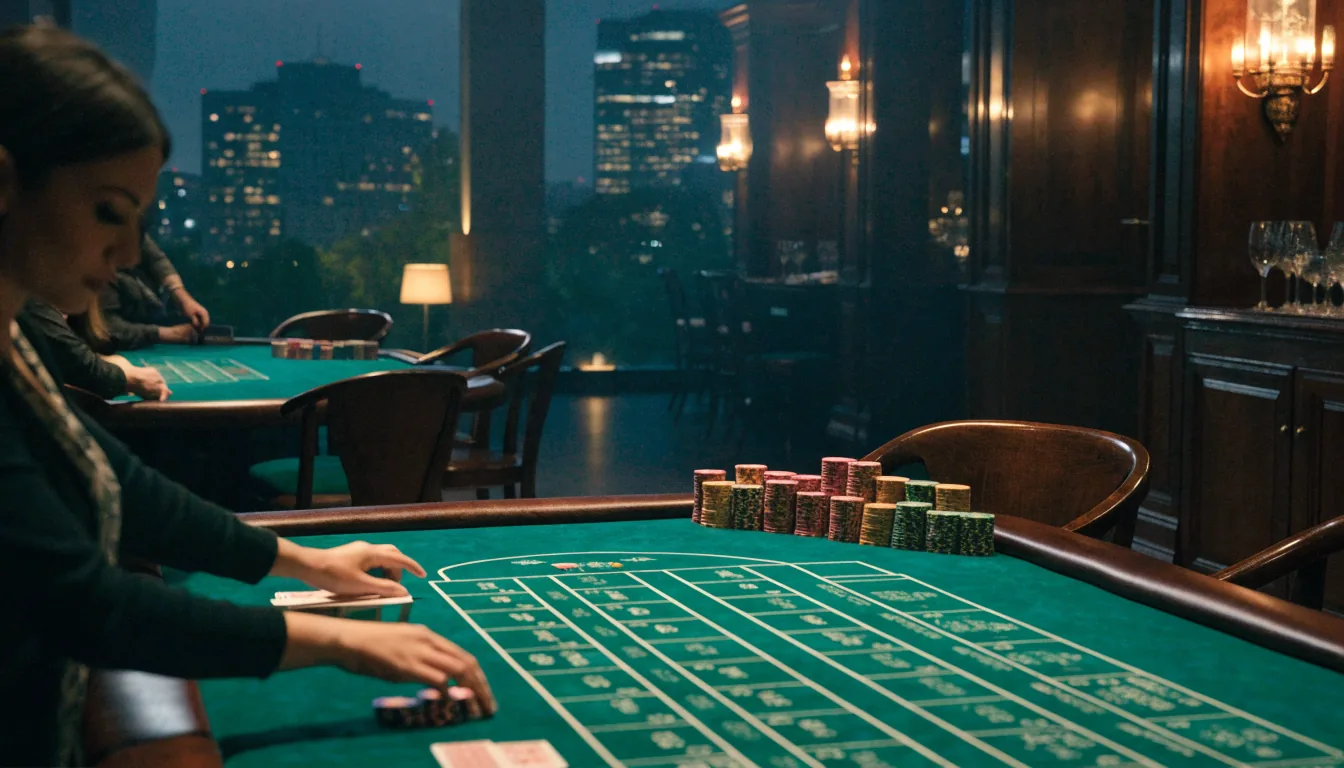
That simple menu can make a card game feel different from one where you are only deciding how to play your own hand. Here, the wager names the outcome you expect. Before placing one, it helps to read the labels carefully: “player” and “Banker” identify the two sides of the comparison, while “tie” is a separate selection. The names alone do not tell you what a winning bet pays or how the hands are determined.
The three options are distinct, so it is useful to treat each as its own decision rather than assuming that one selection covers another. Choosing the player’s hand is not the same as choosing the Banker’s, and neither is equivalent to backing a tie. The betting choice is therefore the central point to understand when looking at this kind of casino card game.
If you are comparing table card games, focus first on what the bet labels refer to. A game that offers these selections asks you to identify which side, or whether a tie, you are backing. That is a narrower question than learning every rule of a game, but it is a practical starting point for understanding the wager screen and its options.
Backs the player’s hand.
Backs the Banker’s side.
Backs an outcome where the hands finish level.
Do not infer a better chance or a larger return from the wording of a selection. “Player,” “Banker” and “tie” describe the outcomes available to back; they do not, by themselves, establish odds, payouts or which bet is preferable. Those details depend on the rules and terms presented for the particular game.
For you, the useful distinction is straightforward: decide whether your wager is on the player’s hand, the Banker’s hand or a tie, and make sure the selected label matches the outcome you intend to back. The labels make the choices clear; they do not replace the game’s rules.
Roulette Variants and Their Number Layouts
The main Roulette variants named here are European, French and American. Their number layouts provide a clear point of comparison: European and French Roulette have 36 numbers and a green zero, while American Roulette has a green zero and a double zero. That is the distinction to keep in view when identifying which version a description refers to.
European and French Roulette share the stated layout: 36 numbers alongside a green 0. American Roulette also has a green 0, but its layout includes a green 00 as well. The difference is not that the American version replaces zero; it has both a zero and a double zero. A short description that mentions only a green zero therefore does not, by itself, distinguish the American layout from the European or French one.
These details describe the layouts, not every rule or feature associated with each version. They also do not establish that one variant is more favourable, or support a comparison of odds. A layout is a limited piece of information, not a verdict on a game.
If you encounter a reference to Roulette in a table-game listing or rules summary, check whether it identifies the variant and states the layout clearly. “European,” “French” and “American” are not interchangeable labels: the stated number arrangement differs for American Roulette. Where a description does not name a version, the green zero alone leaves the distinction unresolved.

The same care applies to claims about access. Describing a Roulette layout does not establish that a real-money game is legally offered to people in Australia, nor does it make a free-play or promotional label a statement about the rules. The layout comparison is simply this: European and French Roulette have 36 numbers and a green 0; American Roulette has a green 0 and a green 00. No further conclusion about odds or suitability follows from those details alone.
Poker’s Aim: Building the Strongest Hand
Poker is a contest in which players try to build the best possible poker hand. That objective is the central idea behind casino poker: the focus is on the hand a player can make, and on how it compares with the hands of others taking part.
The wording “best possible” describes the aim, not a promise that any player will achieve it. Poker is competitive by design: players are trying to produce a strong hand while others at the table pursue the same goal. The result is a comparison between players’ hands, rather than a contest centred on building a hand in isolation.
If you are looking at poker among casino table games, this gives you a useful starting point without assuming that every poker game follows identical procedures. The broad objective remains building the strongest hand possible. Specific details can depend on the particular game, so the name alone should not be treated as a complete explanation of how a session works.
That distinction matters when you encounter different poker-labelled games, including versions presented as casino table games. The shared idea is the effort to make the best possible poker hand; the objective itself does not establish every rule or tell you exactly how a particular version is played.
In short, poker’s defining aim is straightforward: players compete to build the strongest hand they can. Understanding that purpose helps frame the game without confusing its central contest with rules that may vary between versions.
Can you play table games online for real money?
Yes, Australian players can play real-money table games on offshore platforms. Australian-based operators are prohibited from offering these games to residents.
What is the legal status of online table games for Australian players in 2026?
Australian-based operators are prohibited from offering real-money online casino games to residents under the Interactive Gambling Act. Offshore platforms accept Australian players, while the ACMA enforces the restrictions on domestic operators.
Do casino bonuses actually benefit table game players?
They can, but table games often contribute less toward wagering requirements than slots, and some titles may be excluded. Check the bonus’s game contribution table and maximum-bet rules before playing.
Are online casinos legal in Australia?
Australian-based operators are prohibited from offering real-money online casino games to residents under the Interactive Gambling Act. Offshore platforms accept Australian players, and the ACMA blocks unlicensed domestic platforms.
Created by the ”WishWin Casino” editorial team.